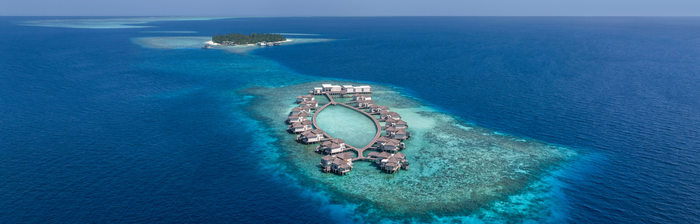
Gaafu Atoll on western maps is sometimes referred to as 'Suvadiva'. Although Huvadhoo can sometimes be mistaken for the largest atoll in the Maldives it is actually the second largest natural atoll in Maldives with a surface area just below 3200 km2. The total land area is about 38.5 km2, and around Gaafu atoll there are many small islands, islets and sand banks.
Gaafu Atoll extends for 82 km from north to south and is 65 km at its widest point in the center. The entire atoll has a round ring of reefs, containing a deep central lagoon with depths of up to 85 meters. Around Huvadhoo atoll you will find many small reefs, small coral islands and coral hills.
The outer reef of the atoll forms an intermittent barrier for the open Indian Ocean; It consists of approximately 40 small reef segments separated by deep, and sometimes narrow channels, connecting the inner lagoon with the ocean from the outside. Around these entrances and canals you will find many fish schools, large manta rays, sharks and other pelagic species inhabiting the deep blue Maldivian' waters.
The natural composition of this Maldives atoll means that there are numerous untouched dive sites full of exciting features such as caves, steep overhangs and beautiful underwater landscapes, not to mention the exciting coral formations and abundance of marine life. Therefore it is not surprising that some dive sites in Gaafu atoll have become world famous, and many liveaboards routes travel to or through Gaafu Atoll.
Gaafu Alifu is a favorite atoll for many, ideal round islands in its heart and its legendary inhabited islands along the edges. One such local island is Gaadhu Island, where the best mats are produced in the world, this is the neighbor of Gan Island on which are the ruins of a Buddhist temple lost in the jungle, and another Fiori island, on which reed is grown for mats, and where you will find one of the best in the country surf spots. Among the Gaafu's islanders the atoll also has its distinct dialect of the Dhikhevi Maldivian language, known as the "Huvadhoo Bas", mainly because of its isolation from the northern atolls in the Maldives.